Material HandlingWhy Use a Team Colloidal Mixer?
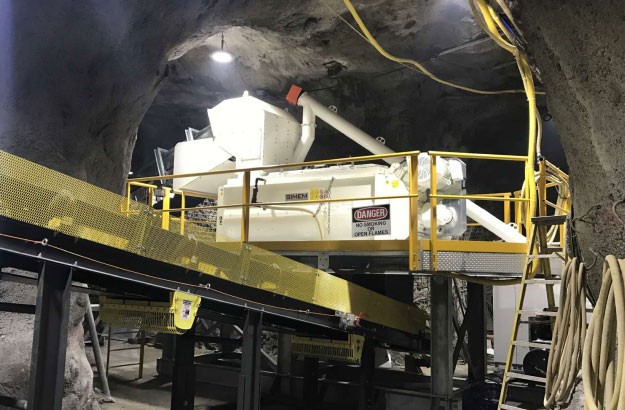
The “Rolls Royce of Mixers” - the high shear colloidal mixer, as used by Team Mixing Technologies, is the leading colloidal mixer in the industry, recommended by most grouting experts world-wide. High-shear colloidal mixers are internationally recognized as the most efficient method of mixing cement-based grouts and other materials. Colloidal mixing results in very stable mixes which resist bleed and water contamination. Rapid mixing of grouts containing sand, up to a sand/cement ratio of 4:1 and neat cement grouts, with water/cement ratios as low as 0.36:1 without additives. Ratios may be even lower with the addition of plasticizers or super-plasticizers. Team colloidal mixers are very efficient at mixing bentonite and other clay products. The mixing process accelerates hydration and produces a more stable, homogenous product. Advantages of Team Colloidal Mixers
Description of Colloidal MixingColloidal Mill: The key element of the colloidal mixer is the colloidal mill which houses a high speed rotor (discar) operating at 2100 rpm within a close-fitting chamber housing. The clearance between the discar and the walls is approximately 3 mm (1/8”). Here, a high turbulence and shearing action is created capable of breaking down clusters of dry cement particles (agglomerates). The colloidal mill also acts as a centrifugal pump and will discharge slurry into an agitation tank. The colloidal mill is capable of generating a maximum discharge pressure of 200 kPa (30 psi) and a flow rate of up to 750 l/min (200 gpm). It is possible to increase the mills efficiency as a pump (thus giving it a higher pressure capacity) but this reduces its efficiency as a mixer. This lower pump efficiency translates into a higher energy input. Depending on the required batch size, one to four colloidal mills may be incorporated into the mixer, each requiring a 22 kW (30 hp) electric motor.
Mixing Tank: The mixing tank acts as a centrifugal separator spinning the unmixed, thicker grout towards the outside of the tank while the lighter portions of the mix move inwards, towards the throat of the tank and into the colloidal mill. Once through the mill, this lighter material is discharged tangentially into the vortex, blending with the unmixed material. Several passes through the mill produces a homogenous mixture. The entire mix cycle, once all materials are added, can take as little as 15 seconds. Control Valves: The output from the colloidal mill is sent into one of two paths. Slurry is either directed tangentially back into the mixing chamber (mix cycle), creating the vortex action, or it is directed to the agitation tank or truck (discharge cycle). Pneumatic or manual pinch valves are used to divert slurry flow. Self Cleaning: After a batch is discharged the mixer is refilled with water. This water is directed through a standpipe in the mixer tank to a spray nozzle which scours the inside of the mixer clean. This water remains in the mixer and is used in subsequent batches. Comparison of Team Colloidal Mixers vs. Competitive Units
Don’t be fooled – all colloidal grout mixers are not alike. Team Mixing Technologies’ colloidal mixer utilizes a “true colloidal mill” that shears the cement particles. Other competitors use a centrifugal pump to simulate the shearing action which in reality, serves as a recirculation pump without the high-shear mixing action. Each Team colloidal mill has two large 200 mm (8”) open throats coupled directly to the feed box, allowing full flow, enabling thicker mixes and allowing easier access for cleaning. Competitors utilizing a centrifugal pump have a small inlet connection, usually 75 to 100 mm, (3 to 4”), causing restrictions and potential cavitation problems with heavier mixes. The discharge velocity of Team’s colloidal mills combined with the tangential inlets on the mixing vessel allows a high velocity vortex to be created resulting in superior mixing. Competitors often need the assistance of a secondary paddle-style mixer to produce a sufficient vortex for mixing. Generally, Team’s colloidal mills require more power than the competitors – up to 22 kW (30 hp) per mill. Power utilized is directly proportional to the shear rate, hence the more power added the more shearing and the more rapid the mixing cycle.
|
Project Books
Mining
Tunnelling & Construction
|